When you click on links to various merchants on this site and make a purchase, this can result in this site earning a commission. Affiliate programs and affiliations include, but are not limited to, the eBay Partner Network.
🚂 What Did It Take to Buy a Piece of the Railroad That Built Grand Central? 🗽
There was a time when owning a piece of paper like this one meant you owned a sliver of the most powerful transportation company in America — a company whose tracks stretched from the Hudson River to the shores of Lake Michigan, whose terminal in Manhattan was rising skyward even as this very bond was being engraved. Hold one of these today and you're holding a genuine artifact of that moment: not a reproduction, not a decorative print made to look old, but an actual corporate financial instrument once bought, held, and eventually cancelled by an investor who believed in the New York Central Railroad's future all the way out to the year 1998.
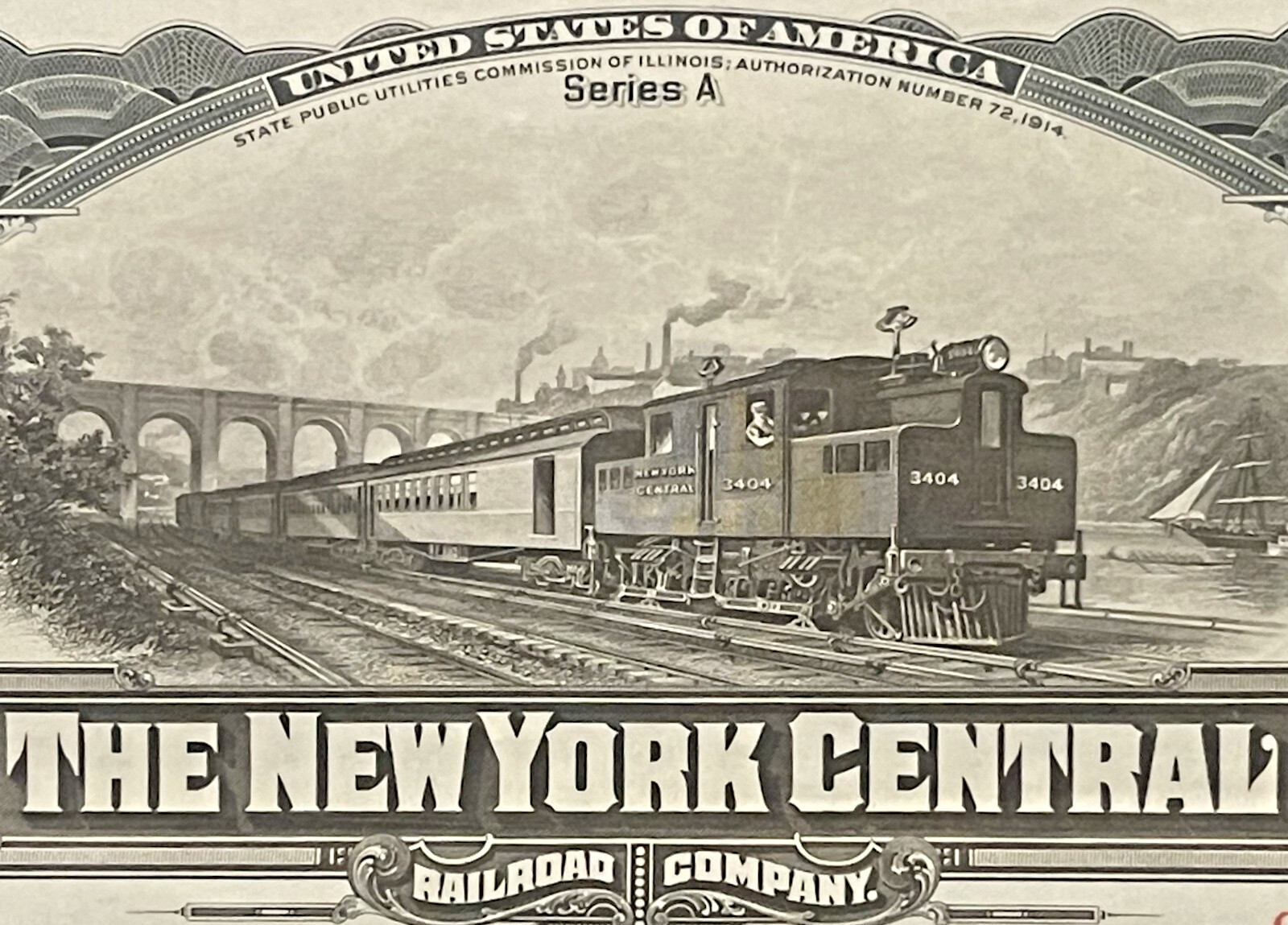
This is a $1,000, 4% "Consolidation Mortgage" Gold Bond, Series A, issued by The New York Central Railroad Company of New York, New York, dated as of August 1, 1913. It was engraved and printed by the American Bank Note Company of New York, one of the great security printers in American history, with Bankers Trust Company standing as trustee over the mortgage that secured it. The certificate measures approximately 15 inches by 10 inches — a tall, substantial sheet of engraved security paper, printed in rich black intaglio ink on cream stock with the ornate scalloped borders, guilloché scrollwork, and dollar-sign medallions that were the signature of fine bank-note engraving in this era. Front and center is a striking vignette: New York Central locomotive No. 3404, pulling a string of passenger cars past a stone viaduct, with a sailing ship riding at anchor in the water beyond — a small scene that quietly captures an entire transitional moment in American transportation, steam power and sail sharing the same horizon. The certificate carries visible punch-cancellation holes, the trustee's mark that this particular bond was formally redeemed and retired from circulation rather than left to run its full course — a genuine piece of the document's working life in the bond market, not a flaw but a fact of its history.
🏛️ The Road That Built an Empire
The New York Central's story begins decades before this bond was ever printed, back in the 1820s and '30s, when a scattering of short lines began stitching together the towns along the old Erie Canal corridor between Albany and Buffalo — the earliest of them the Mohawk and Hudson Railroad, New York State's very first railway. It took Albany's own Erastus Corning, a hardware merchant and industrialist who served four terms as the city's mayor and twenty years as president of the Utica and Schenectady Railroad, to see that these scattered lines would be worth more joined than separate. On April 2, 1853, the New York State legislature approved the consolidation of ten of these small roads, and on May 17 of that year, the New York Central Railroad Company was born, with Corning himself at its head until 1864.
What Corning built, Cornelius Vanderbilt took. The Commodore, already the master of a shipping empire, won control of the Central in 1867 and combined it with his Hudson River line, running the tracks straight into Manhattan. Vanderbilt then reached westward — the Lake Shore and Michigan Southern joined the fold in 1873, the Michigan Central in 1871 — pushing the empire's rails from Buffalo all the way to Chicago. His son, William H. Vanderbilt, kept building, adding the West Shore Railroad in 1885. By the time the system reached its full size, the New York Central commanded roughly 10,000 miles of track, linking New York with Boston, Montreal, Chicago, and St. Louis — one of the true giants of the American Gilded Age.
By the years just before this bond was issued, leadership had passed to Chauncey M. Depew — former United States Senator, celebrated orator, and one of the most recognized public men of his generation — under whose stewardship the railroad pushed forward on two fronts at once: expanding its reach west and, in Manhattan, undertaking one of the most ambitious construction projects the city had ever seen.
🕰️ 1913: The Year of Grand Central
The date printed on this bond — August 1, 1913 — lands squarely in one of the New York Central's defining years. Grand Central Terminal, the railroad's soaring Beaux-Arts monument on 42nd Street, had opened its doors to the public just months earlier, in February 1913, the culmination of a project that also required the railroad to electrify its approach tracks into Manhattan after steam locomotives were banned from the tunnels following a fatal 1902 collision in the Park Avenue Tunnel. The vignette on this very bond — a locomotive threading past a stone viaduct along the water — quietly echoes that moment of transition, when New York Central power was being reimagined for the electric age even as steam still ruled the rest of the system.
The underlying mortgage behind this bond was actually executed a year earlier, on June 20, 1913, by the road's immediate predecessor, the New York Central and Hudson River Railroad Company — a detail confirmed in university archival catalog records of the original trust indenture. Shortly after, in 1914, that company consolidated with the Lake Shore and Michigan Southern Railway and a handful of smaller lines to form the New York Central Railroad Company as it appears printed on this certificate — the corporate name under which this Series A bond issue was ultimately authorized and sold, secured by an eighty-five-year term running all the way out to a maturity date of February 1, 1998, with interest payable each February and August in gold coin of the United States.
🖋️ The Engravers of Trust: American Bank Note Company
The exquisite engraving that makes a piece like this so satisfying to hold didn't come from just any printer. The American Bank Note Company traced its lineage back to 1795, to a firm founded by Robert Scot, who would go on to become the first official engraver of the United States Mint. After the financial Panic of 1857 rattled the security-printing trade, seven of the country's leading bank-note firms merged in 1858 to form the American Bank Note Company outright — consolidating the finest engraving talent in the country under one roof. By the twentieth century, the firm's Bronx printing plant was turning out an astonishing volume of work, at times producing millions of documents in a single day and printing roughly half of all securities then trading on the New York Stock Exchange. That plant and the company's headquarters building, both completed in 1908, are today protected New York City landmarks — a fitting honor for the hands that engraved so much of the paper trail of American capitalism, this bond among it.
🔐 Bankers Trust and the Fine Print of Finance
Named directly on the certificate as trustee, Bankers Trust Company held the legal responsibility of overseeing the mortgage that secured this entire bond series — confirmed in archival records as trustee of "the New York Central and Hudson River Railroad Company... Dated June 20, 1913," matching the certificate's own printed language almost word for word. It was Bankers Trust's role to certify that each bond issued, including this one, was properly authorized against the railroad's pledged assets. The punch-cancellation visible on this certificate marks the moment its working life in the bond market ended — bonds of this kind were retired through redemption, exchange, or the far larger financial reorganizations that would eventually engulf the New York Central itself, and the cancellation is as much a part of this document's history as the engraving that first brought it to life.
📉 From Empire to Bankruptcy: The Long Twilight
The New York Central that issued this bond was, in 1913, riding about as high as any American railroad ever had. It would not stay there. Passenger rail across the country began its long decline after World War II, and the Central was no exception — by the late 1950s it had already dropped four of its six daily fast trains between New York and Chicago. Facing the same pressures, the Central and its once-bitter rival, the Pennsylvania Railroad, pursued a merger that finally closed in 1968, forming the Penn Central Transportation Company. It is remembered today as one of the great cautionary tales of American corporate history: the combined railroad collapsed into bankruptcy within barely two years, in June 1970, at the time one of the largest corporate failures the country had ever seen. Passenger operations were handed off to the newly created Amtrak in 1971, and in 1976 the freight remnants of the Penn Central, along with several other failed lines, were folded into the government-created Consolidated Rail Corporation — Conrail. The company that promised to pay this bond's holder in gold coin all the way out to 1998 had, in truth, ceased to exist as an independent enterprise decades before that date ever arrived — which is part of why so many of these bonds survive today bearing cancellation marks rather than final payment stamps: they were retired and settled in the great reshuffling of American railroading, not quietly redeemed on schedule.
🧩 The Illinois Mystery
One detail on this certificate has genuinely puzzled researchers digging into this issue: printed prominently across the top is a notation referencing the "State Public Utilities Commission of Illinois, Authorization Number 72, 1914." It's an odd thing to find on a bond issued by a New York-chartered railroad headquartered in Manhattan — though it isn't entirely without explanation. The New York Central's Lake Shore & Michigan Southern and Michigan Central lines carried its rails deep into Illinois and all the way to Chicago well before 1913, so it stands to reason that Illinois regulators required some form of authorization for securities of any railroad doing business within the state. The exact statute or mechanism behind this particular authorization number has proven elusive to pin down — a small loose thread left dangling in an otherwise well-documented corporate history, and exactly the kind of detail that keeps scripophily collectors chasing down old regulatory filings for fun.
🖼️ Display Ideas
- 🖇️ Framed alone under glass as a striking piece of engraved Americana for a home office or study wall
- 🚂 Paired with vintage railroad photography or timetables to build out a train-room or man-cave display
- 🏙️ Grouped with other early-20th-century New York City ephemera to tell the story of Grand Central's golden era
- 📜 Displayed alongside other stock and bond certificates as part of a scripophily collection
- 🗺️ Set next to old railroad maps of the Northeast and Great Lakes to trace the New York Central's actual routes
- 💼 Kept flat in an archival sleeve for collectors who prefer handling and study over framing
🎁 Who Collects These
Scripophily collectors — those who specialize in historic stock and bond certificates — seek out pieces exactly like this one for the intersection of American corporate history, fine engraving, and railroad lore all on a single sheet. Railroad enthusiasts and rail history buffs are drawn to the locomotive vignette and the direct tie to the New York Central's Grand Central-era peak. History-minded gift givers appreciate it for anyone with ties to New York, Chicago, or the great Vanderbilt railroad empire, and design-minded buyers simply love the engraved artwork as a framed conversation piece. It also appeals to anyone building a collection around American Bank Note Company engraving, a niche in its own right given the firm's landmark status and storied print runs.
❓ FAQIs this an original 1913 document or a reprint?
This is an original early-20th-century corporate bond certificate, engraved and printed by the American Bank Note Company, carrying the printed issue date of August 1, 1913.
What does "4% Gold Bond" actually mean?
It means the New York Central Railroad Company promised to pay interest at 4% per year, in gold coin of the United States, semi-annually each February and August, with the $1,000 principal due at maturity — a common structure for major railroad financing in this era, before the gold standard was abandoned decades later.
Why does the certificate show punch-cancellation holes?
Those holes were made by the trustee to formally retire the bond once it was redeemed, exchanged, or settled — a standard practice for cancelled bonds, and a genuine marker of this certificate's real working history in the financial markets.
Does this bond still have any value as a security?
No — the New York Central Railroad Company itself was absorbed into Penn Central in 1968 and ultimately into Conrail by 1976, long before this bond's 1998 maturity date, so it holds historical and collectible value rather than any redeemable financial value today.
Who was Chauncey Depew, and is he connected to this bond?
Depew was a former U.S. Senator and one of the New York Central's most prominent leaders in the years surrounding this bond's issuance, guiding the railroad through its expansion and the construction of Grand Central Terminal.
Why does it mention the Illinois Public Utilities Commission?
The New York Central's rail network reached into Illinois and Chicago well before 1913, and it appears Illinois regulators required authorization of railroad securities doing business in the state — though the precise regulatory detail behind this specific authorization number remains an open question even among researchers.
Can this be framed safely?
Its heavy engraved security paper and substantial 15 x 10 inch size make it well suited to framing, whether displayed alone or alongside other railroad and financial ephemera.
Coupons were made to be clipped away, and most bonds of this age lost theirs one payment at a time until only the certificate was left, so a sheet that came through the decades still attached is the exception rather than the rule. When a road went under, holders commonly taped the last coupon back onto the bond and held on in hope of collecting what they were owed, so a bond that still carries that taped final coupon is the better one to end up with. The coupon count can run a few more or a few fewer than what is pictured.
An issued certificate picks up the marks of its working life: endorsements and signatures on the reverse, transfer-agent and registrar stamps, revenue or documentary tax stamps, punch or cut cancellations at redemption, staple holes from being bound into a transfer book, and pencil ledger notations. Those marks are the paper trail of a financial instrument that actually did its job.