When you click on links to various merchants on this site and make a purchase, this can result in this site earning a commission. Affiliate programs and affiliations include, but are not limited to, the eBay Partner Network.
Circa 1894 Dr. J. H. McLean's Strengthening Cordial & Blood Purifier – St. Louis, Missouri
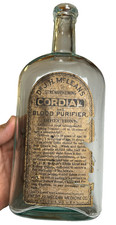
Outstanding large circa 1894 patent medicine bottle from The Dr. J. H. McLean Medicine Co. of St. Louis, Missouri, retaining its fascinating original paper label.
Height: 9 1/8"
The reverse is boldly embossed:
DR PURIFIER
The front retains the original printed label identifying the contents as:
DR. J. H. PURIFIER
Date & Origin
This example dates to approximately 1894, with a reasonable production range of about 1892–1896.
Period advertising from the early 1890s identifies The Dr. J. H. McLean Medicine Company in St. Louis, Missouri, and advertises this exact Strengthening Cordial and Blood Purifier. A specialist patent-medicine bottle reference also documents this large McLean form at 9 1/8" tall, matching this bottle exactly.
Dr. J. H. McLean & His Medicine Empire
James H. McLean was involved in the St. Louis proprietary medicine trade by the early 1850s. His Strengthening Cordial and Blood Purifier was nationally advertised before the Civil War, making it a remarkably long-lived American patent-medicine brand.
By the time this bottle was manufactured in the 1890s, McLean's Cordial had already been sold for roughly 35 years.
The company produced an entire family of proprietary remedies, allowing McLean to cross-promote one medicine on the packaging of another. This label, for example, instructs patients suffering from "Costiveness, or Liver Complaint" to take Dr. J. H. McLean's Little Liver and Kidney Pillets.
What Was In It & What Was It Supposed To Do?
McLean marketed the Strengthening Cordial as a general restorative or "blood purifier" rather than as a treatment for one narrowly defined illness.
Period advertising promoted it for such complaints as weakness, debility, poor appetite, indigestion, stomach complaints, liver and kidney troubles and nervous conditions.
Like many proprietary medicines of the era, its advertising promised benefits vastly beyond anything that could be scientifically demonstrated.
The surviving label contains an especially remarkable claim:
"A large tablespoonful taken every morning before eating is a preventive against Yellow Fever, Chills and Fever, Cholera, or any prevalent disease."
That statement is an extraordinary surviving example of pre-1906 American patent-medicine marketing.
Original Label – Surviving Text
The label reads substantially as follows:
DR. J. H. large tablespoonful.
Young Persons:—10 to 15 years of age, a teaspoonful.
Children:—5 to 10 years of age, 20 drops; 1 to 5 years of age, 10 drops.
The above doses should be taken four times a day. Weak and debilitated patients should take half the above quantity eight times a day.
Where there is Costiveness, or Liver Complaint, take one or more of Dr. J. H. McLean's Little Liver and Kidney Pillets, sufficient to secure a full discharge of the bowels.
A large tablespoonful taken every morning before eating is a preventive against Yellow Fever, Chills and Fever, Cholera, or any prevalent disease.
SOLE PROPRIETORS & MANUFACTURERS
THE DR. J. H. McLEAN MEDICINE CO.
ST. LOUIS, MO. U.S.A.
Medicine in the 1890s
This bottle comes from one of the most fascinating transitional periods in American medicine.
By 1894, physicians increasingly understood germ theory, and antiseptic surgical techniques were becoming established. Scientists knew that microorganisms caused many infectious diseases, and laboratory medicine was beginning to transform medical practice.
At the same time, ordinary Americans could walk into a drugstore and buy proprietary remedies such as McLean's without the sort of federal regulation we know today.
There was no FDA policing these claims. The landmark federal Pure Food and Drugs Act would not become law until 1906, approximately twelve years after this bottle was produced.
That helps explain how a manufacturer could print directly on a medicine bottle that taking a tablespoon every morning could prevent cholera and yellow fever.
Technology & Everyday Life – Circa 1894
America was rapidly becoming a modern industrial society when this bottle sat on a druggist's shelf.
Electricity was spreading through major cities, although many homes still depended upon gas, kerosene and other forms of lighting.
Telephones were increasingly visible in businesses and affluent homes but were nowhere near universal.
Electric streetcars were transforming American cities, allowing people to live farther from where they worked.
Railroads dominated long-distance transportation. The automobile was still an experimental curiosity; most local transportation depended upon horses, wagons and streetcars.
The bicycle craze of the 1890s was underway and would have enormous social and technological influence.
Recorded sound was still novel, while photography was becoming increasingly accessible to ordinary Americans.
There was no radio broadcasting, television or commercial aviation. News traveled through newspapers, telegraph lines, letters and word of mouth.
This bottle therefore belongs to the fascinating moment when Victorian America was beginning to look recognizably modern.
Politics & America in 1894
The United States was led by Democratic President Grover Cleveland, serving his second, nonconsecutive term.
The country was suffering through the severe economic depression following the Panic of 1893. Banks and businesses failed, unemployment rose dramatically and labor unrest became a major national issue.
In 1894, the enormous Pullman Strike disrupted railroad transportation and became one of the defining labor conflicts of the decade. Federal troops were ultimately deployed during the crisis.
Political battles over tariffs, currency, gold versus silver and the power of large corporations dominated national debate.
Just two years later, William McKinley defeated William Jennings Bryan in the presidential election of 1896, and in 1898 the United States entered the Spanish-American War.
St. Louis in the 1890s
St. Louis was one of America's great industrial and commercial cities when this medicine was manufactured.
Its location on the Mississippi River, combined with its enormous railroad network, made the city an important distribution point for companies such as McLean's. Bottles of medicine manufactured in St. Louis could be shipped by rail to druggists throughout the country.
A particularly appropriate St. Louis event occurred in 1894 itself: the magnificent St. Louis Union Station opened that year. At the time it was one of the world's great railroad terminals and symbolized the city's importance as a national transportation hub.
Two years later, on May 27, 1896, the catastrophic St. Louis–East St. Louis tornado tore through the region, killing hundreds and becoming one of the deadliest tornado disasters in American history.
And the city's trajectory during this period ultimately led toward its extraordinary moment on the world stage: preparations during the following years culminated in the 1904 Louisiana Purchase Exposition – the St. Louis World's Fair – and the 1904 Olympic Games.
Why This Example Is Special
The embossed bottle itself is collectible, but the original label dramatically increases its historical interest.
An unlabeled example tells you the product's name.
This one tells you who manufactured it, what they claimed it did, exactly how adults and children were instructed to take it, what other McLean products were being cross-promoted, and even which deadly diseases Americans were told it could prevent.
That makes the bottle a remarkably tangible artifact of late-19th-century American medicine and advertising.
Condition
The glass is bright and clean overall, with attractive aqua coloration and strong, easily readable embossing.
No chips. No cracks.
There is some dust and loose debris resting on the interior floor, but the glass itself presents beautifully.
The original paper label remains substantially intact and very readable, particularly the important product name, directions, disease claims and manufacturer information.
As expected for an approximately 130-year-old paper medicine label, it shows toning, cracking, edge losses and missing areas.
The label also appears to have been stabilized at some point in the past, probably a number of years ago. There are small hints/traces of adhesive visible in some of the cracks and separated areas. This is mentioned for complete accuracy and can be seen in the photographs.
Despite its losses, enough of the label survives to preserve an exceptional amount of original information.
A scarce, highly displayable and historically fascinating labeled St. Louis patent medicine bottle from the golden age of American proprietary medicines.