When you click on links to various merchants on this site and make a purchase, this can result in this site earning a commission. Affiliate programs and affiliations include, but are not limited to, the eBay Partner Network.
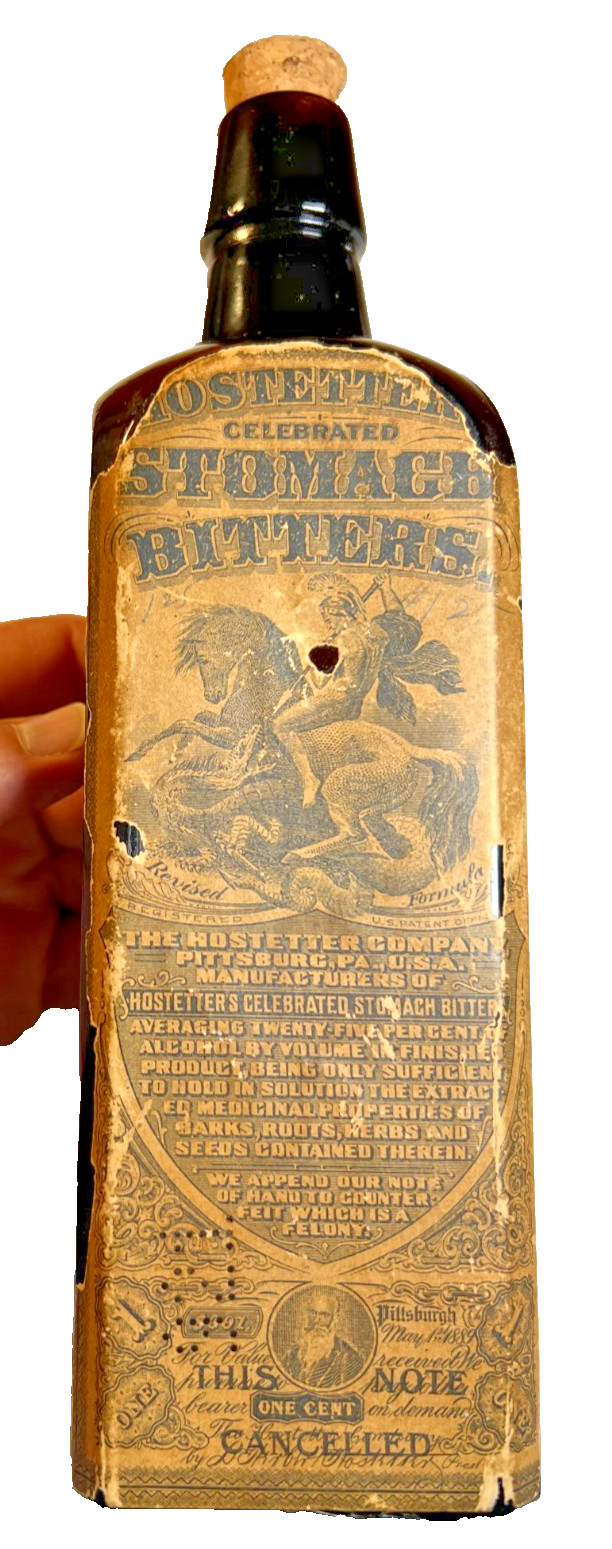
Offered here is a remarkable circa 1917 Dr. J. Hostetter’s Celebrated Stomach Bitters bottle from The Hostetter Company of Pittsburgh, Pennsylvania.
Standing approximately 9 inches tall, the bottle is made from exceptionally dark amber glass—so dark that it appears nearly black under ordinary room light. Both narrow sides are boldly embossed:
DR. J. HOSTETTER’S
STOMACH BITTERS
The reverse shoulder is embossed:
18 FLUID OZS.
Hostetter bottles were produced by the millions, but relatively few survive with such a large portion of their elaborate original paper label. This label is more than ordinary packaging: it is simultaneously advertising art, a counterfeit warning, a medicinal disclosure and an echo of America’s Civil War-era revenue-stamp system.
Precise Date: Circa 1917
This is a later machine-made Hostetter bottle rather than one of the company’s nineteenth-century hand-finished examples. Its construction, standardized 18-fluid-ounce capacity marking and revised-formula label place it within approximately 1915–1919, with circa 1917 being the best single-year estimate.
The label declares that the finished product averaged 25% alcohol by volume. Earlier Hostetter’s Bitters reportedly contained approximately 44–47% alcohol, making it nearly as strong as straight whiskey.
After passage of the Pure Food and Drug Act of 1906, manufacturers faced much greater scrutiny over undisclosed drugs, alcohol and extravagant medicinal claims. Hostetter subsequently reduced its formula to approximately 25% alcohol—the revised version identified on this bottle.
The bottle therefore comes from a fascinating transitional moment: after federal regulation began pulling back the curtain on patent medicines but immediately before national Prohibition transformed the entire American alcohol trade.
The Dramatic Label Artwork
Across the upper portion is a detailed engraved scene of a mounted warrior battling a monstrous serpent or dragon. The imagery is heroic rather than medical: Hostetter was visually presenting its bitters as a powerful defender capable of conquering the ailments afflicting the human body.
The scene is surrounded by unusually dense ornamental printing, including scrollwork, banners, heraldic devices and large shaded lettering reading:
HOSTETTER’S
CELEBRATED
STOMACH BITTERS
Beneath the illustration appears:
Revised Formula
The surviving central text identifies:
THE HOSTETTER COMPANY
PITTSBURGH, PA., U.S.A.
MANUFACTURERS OF
HOSTETTER’S CELEBRATED STOMACH BITTERS
It further states that the product averaged twenty-five percent alcohol by volume, supposedly only enough to keep in solution the extracted medicinal properties of the:
“Barks, Roots, Herbs and Seeds Contained Therein.”
That claim is an extraordinary little piece of marketing. Hostetter was effectively telling customers that its 50-proof strength was not there for pleasure—the alcohol was merely a necessary carrier for the wholesome botanical extracts. One suspects that many customers accepted this explanation with heroic enthusiasm.
The Mysterious Punched Dots
The numerous small, clean, round holes concentrated in the lower portion of the label are particularly intriguing.
These are distinct from the larger irregular areas of ordinary paper loss elsewhere on the label. The tiny round holes appear to be intentional punch marks forming a cancellation, a practice closely associated with fiscal documents, tickets, coupons and revenue stamps.
A punch cancellation physically mutilated a stamp or negotiable coupon so it could not be removed and used—or presented for payment—a second time. The United States Stamp Society defines a punch cancel as the cancellation of a stamp by punching one or more holes through it.
That interpretation fits this label beautifully because the bottom design masquerades as a negotiable one-cent note. The label itself announces:
“WE APPEND OUR NOTE OF HAND TO COUNTERFEIT WHICH IS A FELONY.”
The punched dots would therefore have served both a practical and theatrical purpose: they helped mark the little printed “note” as cancelled while adding to the appearance of an officially processed fiscal document.
The exact letters or figures originally represented by the punched pattern are difficult to reconstruct because portions of the paper are now missing. Accordingly, they should not be interpreted as a readable production date. What can be said is that the small round punctures appear deliberate and historically consistent with a punched cancellation, rather than ordinary random tears.
The irregular holes and missing fragments in the upper illustration are normal losses from age and wear; the concentrated small round perforations in the lower design are a different phenomenon.
Is the Bottom Panel a Government Tax Stamp?
It certainly looks like one—and that was intentional—but on this circa-1917 bottle it is not a separate government revenue stamp.
Its story reaches back to the Civil War.
Beginning in 1862, the federal government imposed taxes on proprietary medicines, matches, perfumes and similar packaged goods to help finance the war. Manufacturers demonstrated payment by attaching revenue stamps to their products. Large companies were permitted to commission elaborate stamps bearing their own names and artwork. Collectors now call these private-die proprietary stamps, or more casually, match-and-medicine stamps.
Hostetter & Smith used genuine federally authorized private-die medicine stamps. A surviving four-cent Hostetter & Smith revenue stamp is held by the Smithsonian National Postal Museum.
These stamps were deliberately made difficult to imitate. Their finely engraved lines, portraits, scrollwork and banknote-like compositions resembled miniature currency. The federal proprietary-medicine tax—and the required use of these stamps—ended on July 1, 1883.
But customers had spent years associating the intricate engraved stamp with authenticity. Rather than discard such a powerful visual identity, Hostetter continued using a related banknote-style design as part of its commercial label.
That is why the bottom of this later label includes:
- A portrait medallion
- Ornate engraving
- ONE CENT
- For Value Received
- Pittsburgh, May 1st, 1883
- Received the Note
- A large printed CANCELLED
- A facsimile signature
- Actual punched cancellation marks
It was no longer proof that a federal tax had been paid. It had become a brand-authentication device styled after the company’s old fiscal paper—an intentional mixture of coupon, promissory note, trademark and advertising art.
The wording dated May 1, 1883 does not date this bottle. It belongs to the inherited label design and predates the bottle by more than three decades.
This makes the label doubly collectible. It appeals not only to antique-bottle and patent-medicine collectors, but also to collectors of advertising, fiscal history, revenue stamps and engraved commercial ephemera. The history of private-die proprietary stamps is outlined by the Smithsonian National Postal Museum and Mystic Stamp’s reference guide.
The Counterfeit Warning
Hostetter’s immense commercial success naturally inspired imitators. The label bluntly warns:
“WE APPEND OUR NOTE OF HAND TO COUNTERFEIT WHICH IS A FELONY.”
The wording is wonderfully theatrical. It tells the buyer that the currency-like device below is Hostetter’s “note of hand” and that reproducing it constitutes counterfeiting.
This was clever brand protection. Instead of merely printing “Genuine,” the company created something resembling a banknote and treated imitation of the package as though it were an attempt to forge money. The portrait, scrollwork, fine engraving, monetary denomination, cancellation and punched holes all reinforced the impression that the bottle had passed through an official system of authentication.
To a customer standing at a drugstore counter around 1917, the label would have looked reassuringly difficult to counterfeit—and impressively official.
About Hostetter’s Bitters
The formula was associated with Dr. Jacob Hostetter, a Pennsylvania physician. His son David Hostetter, working with George W. Smith, began commercially manufacturing and promoting the bitters in Pittsburgh during the early 1850s.
Hostetter’s became one of the most successful proprietary medicines in the United States. It was promoted through newspapers, signs, trade cards and the company’s widely distributed illustrated almanacs. Advertisements claimed that it could address indigestion, dyspepsia, loss of appetite, liver complaints, fever, weakness and numerous other maladies.
The product’s high alcohol content undoubtedly helped its popularity. In communities where ordinary liquor was restricted or socially frowned upon, a bottle of respectable “stomach medicine” could provide a remarkably spirited remedy.
At a reported 25% alcohol, even this reduced circa-1917 formula was approximately 50 proof.
The brand survived the nineteenth-century patent-medicine era, federal reform and Prohibition. It was later marketed under the name Hostetter Tonic and remained available well into the twentieth century.
Original Dry Contents or Residue
Inside the bottle is a dry, approximately shooter-marble-sized chunk of old material.
There is also a faint interior contents or stain line approximately three-quarters of the way up the bottle. Because the glass is so dark, this line is almost impossible to see during normal display and becomes noticeable only when the bottle is examined beneath especially bright light.
The remaining material adds mystery and visual authenticity, but the bottle and its contents are offered solely as historical collectibles and are not intended for consumption or medicinal use.
Condition
- Approximately 9 inches tall
- Deep, glossy, nearly black amber glass
- No chips
- No cracks
- Strong side embossing
- Small open manufacturing bubble on the shoulder
- Faint interior contents or residue line approximately three-quarters of the way up
- Shooter-marble-sized piece of dry unidentified material inside
- Original paper label remains extensively intact
- Label shows age toning, rubbing, tears, edge loss and several irregular missing areas
- Small round punched holes in the lower section appear to form an original cancellation
- Major artwork, company identification, revised-formula declaration and currency-style design remain visible
- Cork is a newer replacement and is not represented as original
The open bubble on the shoulder is an original manufacturing characteristic—not a later chip or impact injury.
A Bottle, Advertisement and Fiscal Relic in One
At first glance, this is a wonderfully dark embossed bitters bottle. Look closer, however, and it becomes something far more layered: an artifact of early American medicine, alcohol history, federal regulation, Pittsburgh industry, banknote engraving, anti-counterfeiting practices and aggressive Victorian advertising.
The punched dots and currency-like panel are not meaningless decoration. They are surviving echoes of a time when bottles of patent medicine carried genuine federal tax stamps—and when a medicine company could make its packaging look so official that purchasing a bottle felt almost like receiving a document from the United States Treasury.
That history, together with the extensive original label, is what elevates this example well above an ordinary Hostetter bottle.