When you click on links to various merchants on this site and make a purchase, this can result in this site earning a commission. Affiliate programs and affiliations include, but are not limited to, the eBay Partner Network.
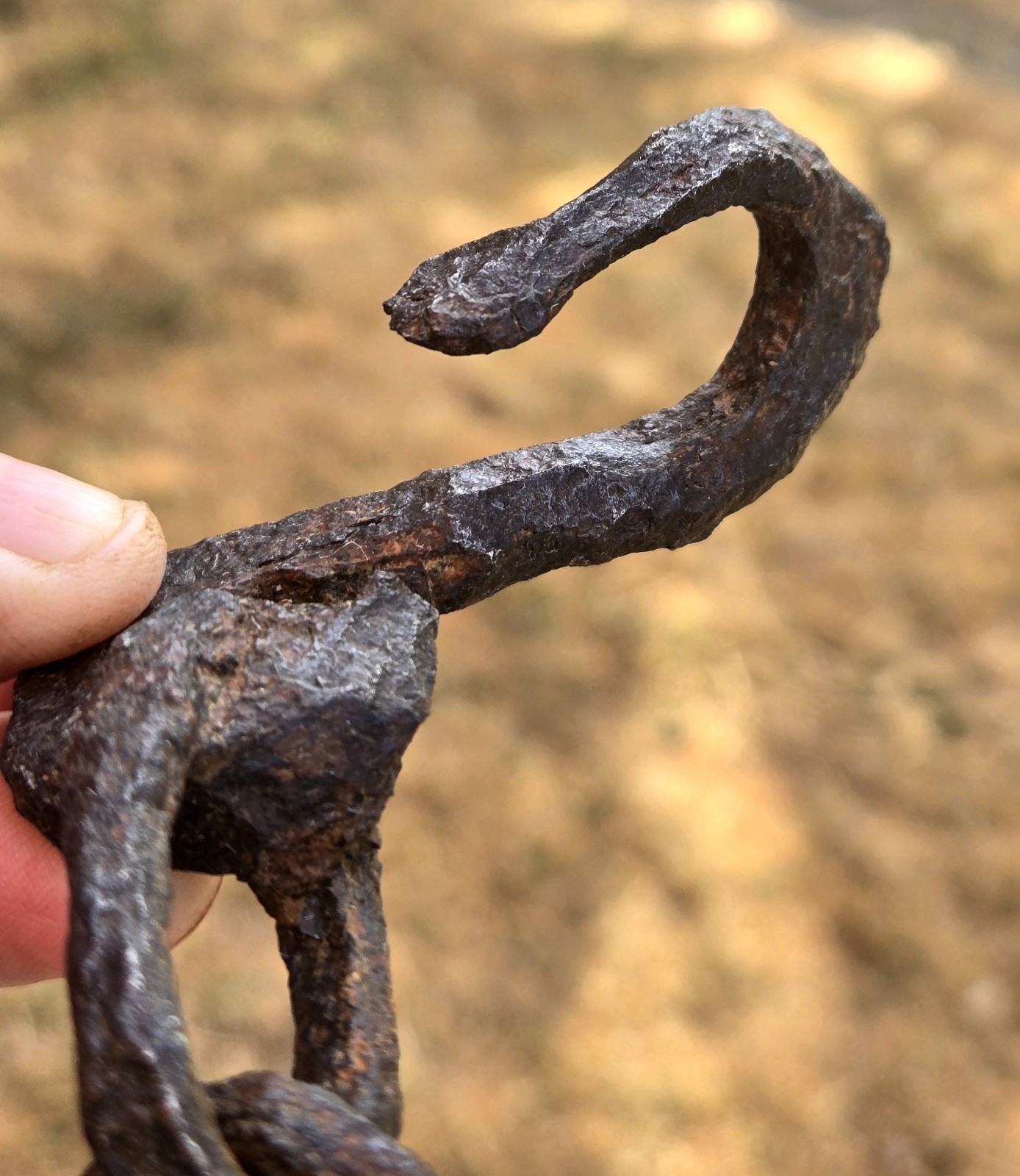
Rare Romano-British / Early Migration Period Forged Iron Swivel Chain with Serpentine Terminal
Artifact Identification: Articulated Forged Iron Swivel Assembly with Serpentine (Caput Serpentis) Terminal
Overview & Historic Context
An exceptional, hand-forged wrought iron suspension chain and swivel assembly, surface-recovered from W Field along the Cambridgeshire Fen Edge. Dating to the Late Roman / Early Anglo-Saxon transition (c. 4th–6th Century AD), this piece represents a sophisticated synthesis of Late Antique iron engineering and early Germanic visual culture.
The assembly features articulated, hand-welded figure-eight links coupled to a central swivel collar—a technical solution designed to relieve torsional stress in heavy suspension systems, such as cauldron rigs, transport tackle, or furnace equipment operating within the local landscape.
Crucially, the functional hook terminal transcends mere utility: the smith deliberately drew down and anvil-hammered the metal to form a distinct, stylized serpent head (caput serpentis). In Northern European metalworking traditions, incorporating beast and serpent imagery onto heavy ironwork served a dual purpose—decoratively elevating everyday functional objects while imbuing them with apotropaic (protective) significance.
Technical Specifications & Condition
- Origin / Provenance: W Field, Fen Edge Basin, East Anglia, UK
- Period: Late Roman / Early Migration Period (c. 4th–6th Century AD)
- Medium: Hand-forged bloomery / wrought iron
- Key Features: Functional swivel collar, hand-hammered interlocked links, sculptural serpent-head terminal hook
- Preservation & Conservation: Fully conserved, desalted to remove destructive ground salts, and sealed with protective microcrystalline wax. The artifact exhibits remarkable structural integrity for an iron survival from arable soil, displaying a rich, authentic dark iron patina and clear historical forge marks.
Site Location: Northern Cambridgeshire Fenedge (Mid-Northern Field Margin / 2.3m Weir Zone) - Georeference: 52°30'13.04"N 0°16'21.84"W
Material: Hand-Forged Wrought Iron (Stabilized Matrix)
Conservation Status: Decrusted, Micro-Abrasive Cleaned, Sealed with museum-grade Microcrystalline Wax.
1. Physical & Diagnostic Assessment
- Dimensions & Mass: Overall Length: 152 mm (Caput Serpentis) Terminal 79 mm x width 35 mm to beast head. Mass: 149.4 grams
- Matrix Integrity: Dense, hand-forged iron core stripped of active corrosion to reveal a stable, dark magnetite surface sealed with Renaissance Wax.
Legal Compliance, Title & Platform Disclaimers
- UK Treasure Act 1996 Exemption: This item is a non-metallic stone lithic artifact. It does not meet the legal criteria of "Treasure" under the Treasure Act 1996 (or the Treasure Designation Order 2023), and is entirely free from statutory reporting requirements.
- PAS & Regulatory Recording Status: Voluntary recording via the Portable Antiquities Scheme (PAS) is currently unfeasible due to severe regional Finds Liaison Officer (FLO) administrative processing backlogs. Full stratigraphic context, GPS coordinates, and diagnostic imagery are permanently archived in the seller's Private Field Register.
- Export Controls & Policy Compliance: Fully compliant with ’s Artefacts and Cave Formations Policy.
General Reference material and further reading:
Where possible ancient artifacts may be referenced to similar material observed in the following publications within my collection:
- British Artefacts Vol.1, 2 and 3: Brett Hammond [Greenlight Publishing 2010]:
- Celtic & Roman Artefacts: Nigel Mills [Greenlight Publishing 2007]:
- SPQR: A History of Ancient Rome: Mary Beard [Profile Books 2015]:
- 50 Bronze Age Artefacts: Portable Antiquities Scheme: Dot Boughton [Amberley Publishing 2021]:
- Pottery in Britain 4000BC to AD 1900: Lloyd Laing [Greenlight Publishing 2003]:
- British Iron Age Coins In The British Museum: Richard Hobbs [British Museum 1996]:
- Swords of The Viking Age: Ian Peirce: [The Boydell Press 2003]:
- Proceedings of the Prehistoric Society Volume 85: [Cambridge University Press 2019].
- Mesolithic Europe: Geoff Bailey / Penny Spikins [Cambridge University Press 2008]
- Viking Art: James Graham-Campbell: [Thames & Hudson, London 2018]
- Roman Coins Vol. 1, 2 & 3: David R Sear: [Spink London 2000]:
- The Roman Cavalry: Karen R. Dixon: [B. . Batsford 1997]:
- Rome’s Saxon Shore: Coastal Defenses of Roman Britain AD 250 – 500: Nic Fields [Osprey Publishing 2006]:
- Amulets of Ancient Egypt: Carol Andrews: [University of Texas Press / British Museum Press 1994]:
The Uniforms of the Roman World: Military dress, weapons, artillery, ships, siege engines and fortifications: Kevin F. Killey: [Anness Publishing 2017]:
Where possible finger rings may be referenced to similar material observed in the following publications within my collection:
- Victorian and Albert Museum CATALOGUE OF FINGER RINGS 1930: C.C.Oman [Anglia Publishing. 1991 – Now out of print]:
- Finger Rings: Diana Scarisbrick / Martin Henig: [Ashmolean Museum Oxford. 2003]:
- Ancient Rings An Illustrated Collectors Guide: T. N. Polio: [McFarland & Co Inc. 2018:
- 1000 Rings: Inspiring Adornments of the Hand: Le Van, Marthe; Ebendorf, Robert [W: Lark Books 2004]:
Copyright AncientPasts 2026 | All rights reserved